My artefact was something I had been so confident about, right from the very start: something I would often get excited about having been inspired by something somebody had produced about the England Tap Team's journey to the IDO World Tap Championships... I was going to produce a documentary.
Within this documentary, my interviews with some of the world's leading tap dancers, teachers and training students of today. Within this I would include excerpts of classes I had observed and demonstrations from teachers and students incorporating the elements I had explored throughout my inquiry, however, this was not to be the case.
Having been kept on a certain timeframe, due to the constraints of my trip to the US, I unfortunately did everything at the last minute... including my preparations of release forms. Whilst I had had them set out for a long time, I had forgotten to send them off with the added condition of using images, and had to send these over to be verified just before I left. I also managed to time my trip really well, it fell right into the middle of the university's holiday. Here I am, emailing my tutor on her holiday, hoping and prying that she may see my message and answer. Thankfully, she did!
I had already started my interviews by this point, so I had to leave out the part about the images being used. Unfortunately, I had gotten a fair way into my interviews by this point and decided that my artefact needed to be changed. How could I present the information I had collated? How could I make something that felt as personable as the documentary I had first intended to make? My time in America was something very special to me, and I felt very privileged that the people who spoke to me, took time out of their busy schedules and spoke to me!
I decided to make a book, or at least the start of one.
There's something prestigious about a book. Your story, bound in pages, with a start, an end, and something in between, and you'll always have something to show, hard evidence that you have achieved something. This is where I would display all of my work and present it in a way that would appeal to teachers and dancers alike. I didn't think much more on this until this past weekend, when I realised that this was not realistic within the current time constraints. Actually, regardless of the time constraints, this wasn't really a practical way to present my work at all!
A book, as I said, has a start, an end, and something in between... but it has an end. I have decided that I want to create something that is easily accessible by all: a book has to be written, published, produced and then bought to get into the hands of your intended audience. It is also very hard to be taken to the exact point you need without a bookmark. I have decided I want to create something that will be ongoing, something that people can add to, something to which people can share their thoughts and ideas: something in which to create a community, a community which currently does not seem to have a place yet in the UK.
I think I have an idea of what I wish to do, but any ideas anyone?
Monday, 20 April 2015

Thursday, 26 March 2015
New York Public Library
So, I have found, during my inquiry, that there is very little literature on my chosen topic, tap dance. So I thought I would use my time wisely whilst I was in America and would go to the Public Library, having seen one previously near Bryant Park.
Deciding then that I didn't have time until the next day, I made my way to class at Broadway Dance Center and happened to meet someone whom I had only heard about from a friend within a conversation at the World Tap Championships in December last year!
I had told this young man about my intentions of going to the library, as he had spoken to me about some books, and he asked why I was going to the standard public library. He then told me of the Performing Arts Library at Lincoln Center, and with that, that's where I was headed!
Having got there, I managed to look up the titles of books I wanted to research and found some, along with some DVDs I wished to watch; although there were not many, there were more than I could find in England! So I made my way over to the aisle where the tap dance books were, and had a hard time trying to locate their numbers. It was only when I saw them all, I realised why... Out of the entire collection of book they had, among the sea of ballet references and modern dance, and musical theatre... meet the tap collection.
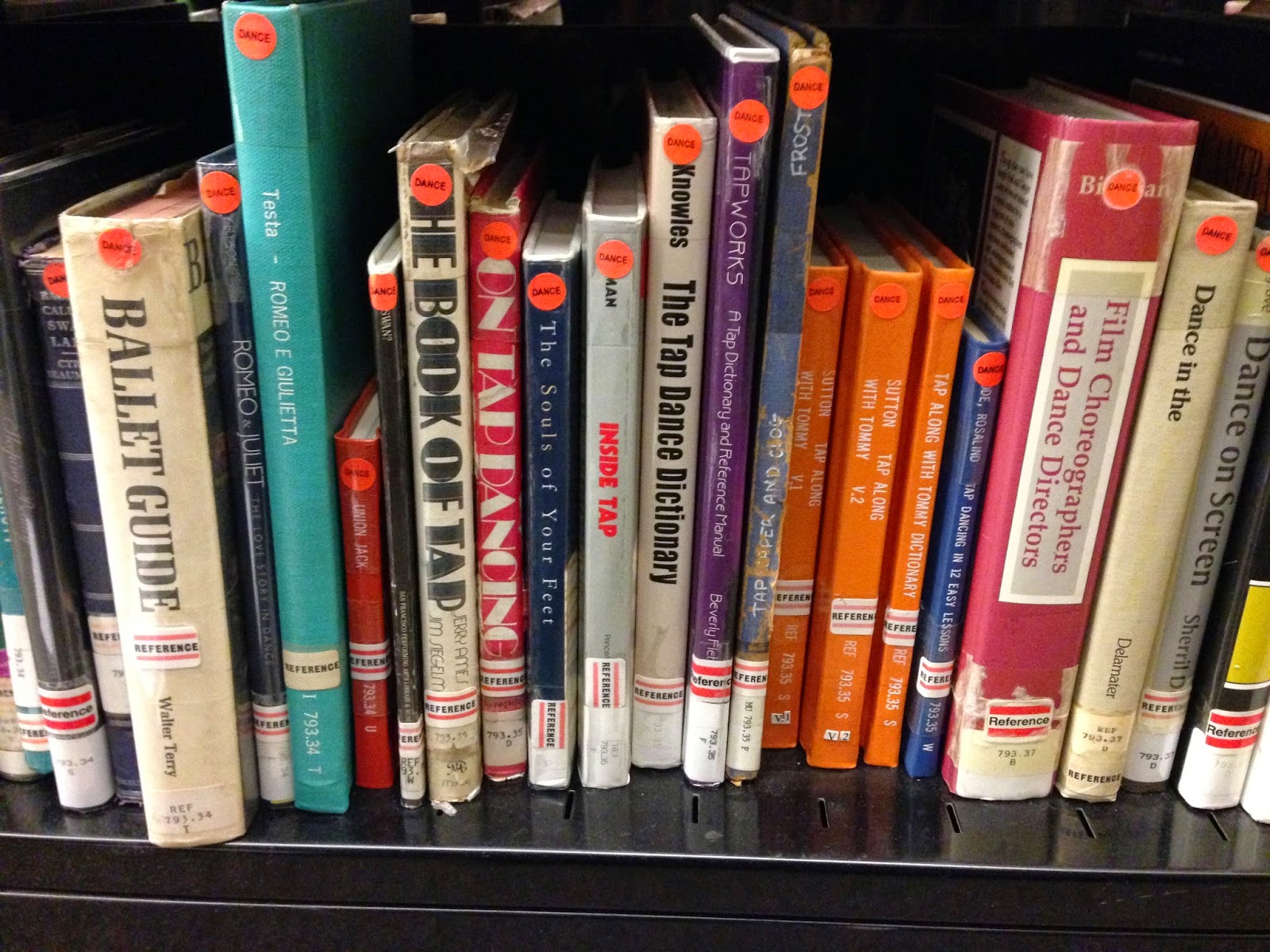
Yes, that's it.
And the one book I had wanted to read, as it's date was after 2005 wasn't even there, somebody had checked it out earlier that day.
So, this resulted in my looking for DVDs.
They had a strange code and I couldn't seem to find them on the shelves, so I asked for help and I was told that I needed to fill out a form and go to the 3rd floor where someone would set me up on a monitor as I had to watch it there. However there was a little hiccough that I found when filling out the form... I didn't actually have a library card! However, small problem, and I'm now secretly quite excited that I own a NYPL card!

Taking my form up to the third floor, I had to remove my coat and bag and leave them in a cloakroom before entering the guarded room. But I found where to hand the form in and was left to watch the 2 films with my own set of controls so that I could play, pause, rewind and fast forward as I pleased. I have to admit, I thoroughly enjoyed my day, but I guess you'll have to wait for my literature review to know what I found!!!
Deciding then that I didn't have time until the next day, I made my way to class at Broadway Dance Center and happened to meet someone whom I had only heard about from a friend within a conversation at the World Tap Championships in December last year!
I had told this young man about my intentions of going to the library, as he had spoken to me about some books, and he asked why I was going to the standard public library. He then told me of the Performing Arts Library at Lincoln Center, and with that, that's where I was headed!
Having got there, I managed to look up the titles of books I wanted to research and found some, along with some DVDs I wished to watch; although there were not many, there were more than I could find in England! So I made my way over to the aisle where the tap dance books were, and had a hard time trying to locate their numbers. It was only when I saw them all, I realised why... Out of the entire collection of book they had, among the sea of ballet references and modern dance, and musical theatre... meet the tap collection.
Yes, that's it.
And the one book I had wanted to read, as it's date was after 2005 wasn't even there, somebody had checked it out earlier that day.
So, this resulted in my looking for DVDs.
They had a strange code and I couldn't seem to find them on the shelves, so I asked for help and I was told that I needed to fill out a form and go to the 3rd floor where someone would set me up on a monitor as I had to watch it there. However there was a little hiccough that I found when filling out the form... I didn't actually have a library card! However, small problem, and I'm now secretly quite excited that I own a NYPL card!
Taking my form up to the third floor, I had to remove my coat and bag and leave them in a cloakroom before entering the guarded room. But I found where to hand the form in and was left to watch the 2 films with my own set of controls so that I could play, pause, rewind and fast forward as I pleased. I have to admit, I thoroughly enjoyed my day, but I guess you'll have to wait for my literature review to know what I found!!!
Monday, 2 March 2015
M3 - Stark Realisation
So my last couple of weeks have been less about actually looking into my topic of inquiry and more setting up meetings and interviews and getting the resources and equipment needed for the next part of my inquiry, so it wasn't until last night when my brain got switched back onto the subject.
Having had a day of holding auditions in Kent for one of the places I work, myself and the lady who runs the organisation walked through her front door to her son who seemed very please with himself. Her son, Kai, is 12 and told us he had spent his day working on a step the entire day (a double wing on one foot for those of you who understand tap terminology, for those of you who don't IT'S HARD!) and that by the end, he had accomplished it. Now, neither I, nor his mother can do this step, and although the kid is really quite ridiculously good, a little bit of doubt had set, so in the end we got him to get his tap shoes out.
Took a couple more attempts than he'd planned, but yes, he did it!
It made me think. This is a step that doesn't appear anywhere in any of the UK's syllabi. A single wing does, and the explanation of the double is easy enough, just nobody is asked to try it! If a twelve year old can do it, because he is willing to try, why do we not offer this to everybody?
This was not the only step that Kai gave me last night. I have been trying to sort out classes for next term in this certain workplace, and myself and the rest of the teachers have put together a list of steps to work from, and are trying to come up with more, as our seniors have nearly exhausted our current repertory and there are only so many times that we can go elsewhere for inspiration, or so much time we have to explore by ourselves in a studio, or sometimes it is simply a fact of we have got to a point where our brain blocks itself off. This is where children and the next generations come in yet again.
People have no option but to use what we provide them with, but it takes a certain mind set to be able to explore. Within a syllabus, people are taught that this exercise is right, or wrong, with very little in between. They are also taught, "At this standard you should do this, and once you have gotten to the end of the syllabus, there is nothing left for you!". This was something that Kai disproved to me last night. Kai, had taken a standard step (Shuffle Pick up - which is one of the syllabi's staple steps) and simply added things to it. Yes, within syllabi, this simple step is adorned with a few things here and there, and a few changes of leg etc, but not to the standard that Kai had shown last night. He had put thing together in a way that I never would have thought, and whilst I relished in the fact that this little human had done this, and grabbed a notepad to write these new fangled (for my eyes, somebody will have done them somewhere) steps down, to try them out myself (I failed abysmally might I just add, but I will work on them), I am a little scared, as I have known it happen to me at a slightly younger age, that there are many teachers who would look at his feet and tell him that "That's not a step in tap", purely because it does not arise in their known tap syllabus and it is not something they recognise.
This has gotten me back to me looking at my inquiry questions and making sure that they are truly what I wish to find out and who I need to be looking at to make a change, if possible. Sometimes it takes one person, no matter how old they are to make you sit back and re-evaluate.
Thursday, 6 November 2014
Interview 1
WOW!
Today I went to conduct my first interview that I would use in my new inquiry, "Tap Dance training: Are current methods in the UK preparing the dancers of today for tomorrow’s stages?"
Well, I didn't actually ask any questions.
I didn't really give much insight into my chosen topic.
I didn't really speak much at all!
I just let this lady talk.
... and I'm so glad I did!!!
There are so many things that she brought up that I had not even considered. It had not even crossed my mind that it may also be the teachers holding students back because of themselves, not because of outside influences or limitations.
I had thought of the way to ask questions, and had actually formulated them to ask at each interview. However, having not asked any questions and had all of this extra information thrown at me, it's clear that these questions need tweaking somewhat. I can also see that there is more than one way I can look at this inquiry, and that I need to re-look at what I want this to achieve, both immediately and in time as the way I conduct this could affect a good many people.
I did not intend to name and shame people in this inquiry: I still don't. But I feel as though I am able to put some of the events and anecdotes into it, as long as I feel it adds something to my inquiry, and is not used with malice.
Well, time to think fast!!!
Today I went to conduct my first interview that I would use in my new inquiry, "Tap Dance training: Are current methods in the UK preparing the dancers of today for tomorrow’s stages?"
I didn't really give much insight into my chosen topic.
I didn't really speak much at all!
I just let this lady talk.
... and I'm so glad I did!!!
There are so many things that she brought up that I had not even considered. It had not even crossed my mind that it may also be the teachers holding students back because of themselves, not because of outside influences or limitations.
I had thought of the way to ask questions, and had actually formulated them to ask at each interview. However, having not asked any questions and had all of this extra information thrown at me, it's clear that these questions need tweaking somewhat. I can also see that there is more than one way I can look at this inquiry, and that I need to re-look at what I want this to achieve, both immediately and in time as the way I conduct this could affect a good many people.
I did not intend to name and shame people in this inquiry: I still don't. But I feel as though I am able to put some of the events and anecdotes into it, as long as I feel it adds something to my inquiry, and is not used with malice.
Well, time to think fast!!!
Monday, 3 November 2014
Devon Youth Jazz Orchestra
There are so many jobs that I do where I turn up, teach to a certain piece of music, with the planned steps, and leave again. Although this one may have been a little different it wasn't until I had been there a night that I realised how beautifully this tied in with my university work!
A colleague and myself had been asked to go to a residential centre in Devon on Thursday night, in lieu of teaching them a routine on the Friday morning.
The only difference being... not a single person had previously taken a tap dance lesson!
The people we had been asked to take this class with were the Devon Youth Jazz Orchestra who thought it would be fun for someone to come in to teach them tap during one of their residential weekends.
As these people were beginners, my colleague an I had free reign on what we could teach them: this is where my syllabus vs free training has a part to play.
We chose not to go down the syllabus route as this may have been a little degrading to find out that this is what 5 year olds start with, regardless of the fact they have never done tap before, and for the fact we only had them for a short amount of time, syllabus work means that there are many small combinations to learn, which could be a little overpowering for someone who has not tapped, and potentially be quite tedious.
We chose instead to teach them a few steps that we deemed basic (although some of these do not appear until the vocational syllabi at the end of the ISTD training system) and carry on by teaching them a slightly longer routine which may better reside in their heads.
I found teaching an entire group of complete beginners very interesting. None of these aspired to be a professional tap dancer in any way, but there were some individuals in the room that did want to succeed at what they were given that day, and there some, even working in that short while that showed great potential.
The routine we taught was not the easiest of routines and would not have been deemed appropriate for a grade 3 student (many of those in these classes were 11 and 12 years old, it would not be uncommon for this age student to be in a grade 3 class). I cannot say, by any means that those in the orchestra class would be as technically sound as people who had danced in a syllabus class, but I cannot speak for all, and technique was not focused on in the 1.5 hour lesson that each orchestra group had, therefore I cannot say whether this could be improved upon over time.
Having a free class allowed us to get through a lot of work in short amount of time and kept the students interested and alert as everything was new and they had to concentrate if they wanted to know what to do.
I think it would have been very interesting had I been able to continue with regular classes for Devon Youth Jazz Orchestra to see how things went over a period of a few weeks. But for now I would say that not doing syllabus work was the best choice to get as much out of the kids that we had, therefore, in my books, 1 up to free work!
Tuesday, 13 May 2014
Module 2 - Critical Reflection
Module 2 ‘Professional Practitioner Inquiry’ was something
that I got quite excited about when I read through the Handbook, but it wasn’t
until the first campus session that I really got involved in the work.
I very much wanted to improve on Module 1 as I was
disappointed in myself and the work I had put in, so I tried to remedy this, only
to realise, halfway through the second module, through one of the members in my
SIG that my blog had been hacked and was not visible to the public. At this
time I got a little despondent, but soon pulled my socks up and got back on
track.
The difficulty I had at the start of this module was simply
the topic of my inquiry. I first veered towards the generic psychological
aspects of the dance world, but decided very early on that this was very
generic, and decided instead to section every aspect that I could have looked
at as I was still so undecided in which topic to choose (see Appendix 4.1)
This is when I had to look at myself. At this time I was,
and still am in a state of transition: I had been injured for a long period of
time, however, at this stage, my injury has healed to the point where I can now
properly dance on it. It still causes problems at times, but I am usually able
to get through the whole of a class. With this in mind, I did not know whether
I would be going out and auditioning for performance work and therefore did not
know which question route to follow. Thankfully, this is where I embarked on
the wonder that be the SIG. I told them my situation, and they help me to get
my questions down to only 2, (see Appendix 4.2) They advised that I could use
everything I knew from my past in a vocational school, or that I could branch
out into what I currently do now, and reminded me that I am likely to one day
come back to what I am currently doing and that I am in the right position and know
the right people to do enough research for the inquiry. They also pointed out how
much I seem to enjoy what I am currently doing: managing a large part of a
dance organisation, and that I am likely to enjoy the inquiry more if I am more
passionate about it. This was the deciding factor for me. My inquiry then
became “Health and Safety in Dance Training: Help or Hindrance?” (see Appendix
4.3)
My starting in the research to this may not actually have
seemed related to my inquiry, but I felt that I had to check whether I may
assume that all dance teachers can be treated as equals, even though they are
individually assessing a situation, guided by their own opinions and morals
(see Appendix 4.4)
Ethics was
something that I enjoyed, but the results shocked me! Being honest, I did this
alongside my researching in Section 4, so was not completely aware of all of
the ethical issues that should be involved in the workplace: I had morals, and
knew loosely about the legal side of things, so the generic thing of policies
came to mind, but I don’t think I could have named (under a legitimate heading)
anything else that was supposed to be in place. Therefore, in my head, I had to
go through the introduction I had when I first started my term of employment,
or at least what I thought had happened! (see Appendix 5.1) Task B was the
thing that really did shock me. I expected to have missed out many policies
that my place of work had, and when I found out that there was only one in
place I went into a state of panic! I wholly believed that this would be
unlawful, and spent a long time doing research, scared of asking my SIG whether
they had any better insight than I about this. I found on Dance UK (2011) that
organisations are to have the following policies in place, as appropriate to
their practice.
·
Child protection.
·
Disability including reference
to disabled dancers in a company.
·
Equal opportunities.
·
Health and Safety – general.
·
Injury prevention and
management.
·
Eating disorders
This, definitely showing more than one policy, still scared
me. So I decided to do some more digging, and spoke directly to the NSPCC and
to the department of Sport Education, on the premise that I was to start a
dance organisation, with exactly the same credentials as the one I currently
work, and yes, as long as everything is covered in the policy, the single
policy was fine. (see Appendix 5.2)
Having been so surprised about the little I knew about the
ethical issues in one task; when my topic of inquiry is so heavily based on
such, I needed to make sure that everything was in order for my inquiry. And
got to working on my ethics form with the help of the reader. I was very happy
with such until I came across a comment on a blog, regarding the anonymity of
children in the inquiry, and very much agreed with this. Even though the quote
was with regard to very young children, I thought that it was a very good idea
to keep the identity of any minor hidden, and have chosen to follow this in my
own inquiry.
“For my inquiry I hope to give interviews,
observations, basic surveys and internet research for biographies, but when it
comes to the face to face stuff, I've decided to ask permission for the
teachers I would interview whether or not they want to be made anonymous or
not, but to put a strict rule to keeping the mentioned children anonymous full
stop.”
GALLACHER. K. (2014) Task
5d Ethics [Online] 16th
April 2014. Available from: http://natalieamartin.blogspot.co.uk/2014/04/task-5d-ethics.html
. [Accessed: 10th May 2014]
As I felt that I needed to further integrate ethics into my
work, I decided to carry out informal trials before presenting the support form
to my employer. This was something I greatly enjoyed, and was excited to see
how passionate people were about my choice of topic: When I first sent out my
survey, I didn’t expect anyone to reply! I found it more difficult when leading
a focus group to not taint people’s answers as a small difference in tone of
voice can hold completely different connotations! I realised at this point,
that there must be a lot of hypothetical research in my chosen topic, as I will
be working with uncomfortable issues for some, but I quickly realised that this
will not impact too heavily on my inquiry. For example, I can simply point to a
place on a child’s body, rather than actually touch it, and all will know where
I am talking about. In this case, the physical contact is not necessary. This
is when I decided to approach my employer with my form, and I am glad for
waiting, as she did ask many questions and how it may impact.
I wanted to keep my collation of information open, as I see
a need for 3 of the tools to address my questions. For children and parents I
feel that a focus group is best: to be able to get the opinions of many
together and to enhance confidence. For teachers that I am not in close contact
with, or those who may be less experienced: a survey sits best. And for those
who I believe to have the best knowledge of the subject from all 3 perspectives,
and also now including dance training boards: a separate interview provides the
most in depth and interpersonal response.
My award title, I feel, reflects my endeavours for the
betterment of my workplace for all. I organise all student data and timetables
for both students and teachers, and the curriculum they are to cover in
lessons. I also take part in the choreographic elements that they are to be
involved in, and help to decide who may be in a performance if there is on to
be staged. I always want to find better ways to do all of this, whilst looking
out for the dancers’ well-being and trying to dramatically improve their dance
ability as I feel that some people have just got into a habit of going to a
syllabus class, repeating the same thing each week and becoming complacent. I
want to be able to push people and to see quicker improvements in people. I
also believe that this is something that builds the confidence in the dancer,
and I feel that the entire workplace could benefit from my inquiry, therefore I
feel it plays a hand under the banner of Arts Management (see Appendix 6).
Overall, I can say that Module 2 has expanded my ability in
how to research a topic, through different leads and different devices and that
I must be aware of the ethical issues before I do anything in my line of work
(not just for this inquiry). I am much more aware of the effect that something
I do or say may have on others and now know what to consider, and how to
control these situations, thus I now feel prepared for my inquiry.
Appendices:
4.1: MARSHALL. J. J. (2014) Starting Module 2. [Online] 15th April 2014. Available
from: http://jjmarshall.blogspot.co.uk/2014/04/starting-module-2.html
[Accessed: 13th May 2014]
4.2: MARSHALL. J. J. (2014) Lines of Inquiry – Part 2. [Online] 17th April 2014. Available
from: http://jjmarshall.blogspot.co.uk/2014/04/having-got-small-amount-of-feedback.html
[Accessed: 13th May 2014]
4.3: MARSHALL. J. J. (2014) Lines of Inquiry – Part 3. [Online] 19th April 2014. Available
from: http://jjmarshall.blogspot.co.uk/2014/04/lines-of-inquiry-part-3.html
19th April 2014 [Accessed: 13th May 2014]
4.4: MARSHALL. J. J. (2014) Task 4D – Literature Review – Book 1. [Online] 7th May 2014.
Available from: http://jjmarshall.blogspot.co.uk/2014/05/looking-within-classes-of-which-dance.html
[Accessed: 13th May 2014]
5.1: MARSHALL. J. J. (2014) Professional Ethics – Task 5a [Online] 17th April2014. Available
from: http://jjmarshall.blogspot.co.uk/2014/04/professional-ethics-task-5a.html
[Accessed: 13th May 2014]
5.2: MARSHALL. J. J. (2014) Professional Ethics – Task 5B. [Online] 5th May 2014. Available
from: http://jjmarshall.blogspot.co.uk/2014/05/professional-ethics-task-5b.html
[Accessed: 13th May 2014]
6: MARSHALL. J. J. (2014) Task 6C – Award Title. [Online] 6th May 2014. Available
from: http://jjmarshall.blogspot.co.uk/2014/05/task-6c-award-title.html
[Accessed: 13th May 2014]
Wednesday, 7 May 2014
Task 4D - Literature Review - Book 1
Looking within classes of which dance is taught, I must look
firstly at the two things that must be in place for anything of this sort tow
happen: somebody to learn from, and somebody to teach. However, with health and
safety being my focus here, most of this responsibility is to be put upon the
teacher, and I will therefore start with them:
As I wanted to set something out for each teacher, I must
first look at how much sway is given for personality traits, and whether this
is something that is taken into consideration. Therefore my first book is
“Personality and Intelligence at Work” by Adrian Furnham
So looking at the section on individual differences at work,
it talks about differences in personalities, and whether this has any effect on
their success within the workplace, neutral of the type of job:

Although I have not conducted a study myself, nor gathered
secondary information, it does give theories that others have come up with.

This was not something that I wanted to go too deeply into,
but was something that I felt needed to be addressed early on in my
investigations. It may arise at some time, deeper into my inquiry when I open
new paths to follow. However, from the findings here, I am quite happy to
generalise my findings to all teachers, however I must pay attention to the
external, situational factors and set things out in this way: If all teachers
are expected to act upon the same morals, the action of the teacher is
therefore dependent on the circumstances.
Tuesday, 6 May 2014
Task 6C - Award Title
Looking at choosing my award title, I had quickly glanced
over them and considered my options, as everybody had been given them same
sheet, I posted this to my SIG for people to leave comments on. I had numbered
them on the group page, but will name them here:
BA (Hons) Professional Practice…
(Dance): I feel that this is a little too general, and I
feel that I have more to offer than just dance
(Performing Arts): Whilst this bears more depth I feel that
I will more on from this one day and feel that a different title may encompass
more of what I want to do a little further down the line.
(Musical Theatre): Now as much as musicals excite me, and I
have no problem with the choreography, some of you have heard m sing, and rest
assured, this is not something I feel I have the calibre to earn a degree in!
(Arts Management): This was something that stuck out for me.
I am currently managing a large part of a dance organisation and feel that I am
competent in such, and am always looking for ways of making the entire body of
work better for everyone, and feel that this ties in somewhat with my inquiry.
Although previously stated, I cannot sing, but I am a competent dress maker and
have no problem with set design and have no fear in finding out who I may need
to go to in order to get what is needed, and am very much aware of the legal
traits behind things.
(Performing Arts Management): This is also another title I
feel that I would like to work towards, and actually one that my inquiry is
probably better suited. However, to me, this implies the management of
individuals, sending them to shows and getting people jobs: I believe I am
capable of this, but my current job includes administration as well as teaching
and ordering necessary items, and feel that I am better doing lots in one
organisation, rather than the same thing for many different organisations.
(Theatre Arts): I do not have much experience in Theatre
arts, per say. I have a diploma that is primarily in dance, and I don’t believe
that GCSE drama will get me very far in this.
(Dance Teaching): This does somewhat apply to me, as I do do
a fair amount of teaching, however, this is not the only route I wish to go
down. This is does however apply to my inquiry, but I believe that the subject
of my inquiry could benefit more than just myself, teaching.
(Graphic Design): Erm, being honest… definitely not my
field!
Having spoken with my SIG they agree that one of the ‘Management’
titles best suits me, or at least at the moment. One person who had known me
before I started the BAPP course said that she thought of me when she first
read the ‘Arts Management’ title!
Now, trying to write a rationale for such.
I feel that BA (Hons) Professional Practice (Arts
Management) is best suited to me: I currently work with a dance organisation,
organising teacher’s timetables, sorting auditions, writing terms &
conditions and liaising with parents about classes and general feedback,
sorting registers and residential training sessions, handling merchandise
orders, whilst teaching and staying aware of any opportunities that may arise
for both myself or the dancers I teach. I wish to dance with a professional
company in the near future, but have had some time off due to injury, which is
where I first started looking at teaching, however, not being able to dance,
teaching proved hard, and I started to take on some administrative tasks. It
was during this time I became aware that the dance world is not just physical
body movements, and the hiring and firing of dancers, walking in and out of the
doors as if nothing had happened, and when I realised how unprepared I was for
the business that I was about to go into! This is where I started picking up
more tasks and getting more involved with things, when I discovered a real
passion for the wellbeing of everyone is the organisation, not only the
dancers, but the teachers and parents too, and I relish in finding ways in
which to make things run smoothly, always with the thought, communication is
key! This is why I have chosen to take my inquiry into health and safety,
looking at how each group of people can benefit from this and making the
organisation a more comfortable place to be in and for those involved to
thrive. This in itself should produce a higher standard of work, both inside
the organisation which I work, and for those outside, allowing for more opportunities
in the future!
Monday, 5 May 2014
Professional Ethics - Task 5B
Having been sent the ONLY policy that we have, I am surprised to find out, that according to the NSPCC and Sport Education everything is completely legal! We only have a safeguarding policy; however this covers everything from data protection, to grievance, to personal relations, and include all the extra sections for children.
I do notice that the policy often says to not ‘engage in inappropriate behaviour’. It does, in some cases state the types of inappropriate behaviour, but not its actual limitations. It is to be understood that each situation is different, but it is not shown where a line is to be crossed.
The use of social media sites is actually recognised in the policy, with regard to photographs and videos of dancers being used, however, the staff use of social media sites is touched on.
Confidentiality is very much stressed in the policy, even within the organisation itself. If an allegation is being made, the person that the allegation is being made against may not know at the start. This is something that I had forgotten, and now sit here hoping that I haven’t done anything to anger anybody in any way!
“Every effort
will be made to ensure that confidentiality is maintained for all concerned.
Information will be handled and disseminated on a need to know basis only. This
includes the following people:
·
The Director
·
The parents of
the person who is alleged to have been abused
·
The person
making the allegation
·
Social
services/police
The organisation will seek social services advice on who should approach the alleged abuser (or parents if the alleged abuser is a child).”
It states that each employee must be interviewed and trained in areas that they seem to be lacking. And as previously stated, all employees need a DBS check, and are covered by the organisation’s liability policy, however, they are to be made aware that they are not covered elsewhere!
The organisation also has a guidance booklet for all dancers and parents (which I wrote, and definitely know what is in such), giving them an idea of what is expected of them, and what they can expect from us for the next year. They are also given terms and conditions that they are to sign: this is for us to be abe to pull people up on things if we feel that they are in breach of these, however, in this it is stated that they are able to see our policy and they will not be frowned upon if they ask for a copy of it, and are completely within their rights to say if they feel as though they have been treated inappropriately.
I was very surprised to find out that we only have one policy, and was convinced that we had more, even from when I had read ‘them’ before, but I was obviously given all the documents that are given and it was my fault, and misunderstanding that these were the policies. With all this being said, I do believe that our policy could be split up into small ones, as it is very long as it covers everything, and could be taken down into smaller chunks that can be more easily digested.
Saturday, 19 April 2014
Lines of Inquiry - Part 3
With much contemplation and through the receipt of
information from many of those who I feel would be contributing substantially,
I have chosen to look at “Health and
Safety in Amateur Dance Training: Help or Hindrance?” This is for the
reason that I am more easily connected to those who I am likely to collate
information from, and they are more reliable in responding to my questions.
Whilst those I contacted regarding the other subject, “Vocational
Schools: Am I here to use the institution for the betterment of myself, or for
the sake of the institution itself?”, were very explosive in what they wrote,
however, they tended not to actually answer my questions; yes, this may be good
in an explorative sense, it would be nice to actually be able to put some answers
to the questions I had asked, and I feel that through direct answers I could
further explore.
I also feel very strongly about the latter question and feel
that I may somehow skew the information I am given, whereas I am purely
inquisitive about the health and safety topic, and am intrigued what people
think in this area. Whether teacher’s opinions differ from those of parents,
and once again differ from those of students.
From here I plan to discuss further with my SIG in which
other ways I can move forward with this, and plan to conduct f=some
investigations to find out, in which way is best for me to collect and collate
my information.
Thursday, 17 April 2014
Lines of Inquiry - Part 2
Having got a small amount of feedback using a social media
site, I have once again slimmed down my lines of inquiry and am now able to
split them up in to smaller inquiries. These will be more focused on one point
and may go deeper into the subject, rather than just being a brief overview:
Having asked both professional dancers, and dance teachers:
the two realms in which I am currently working, there was a massive response to
two of the lines in particular.
The dancers having been through a vocational school and now
in employment, very much sided to:
“Schools and Colleges:
Am I here because I deserve to be, or to pay for another?”
They felt very strongly about this and had much to say about
it, however, not quite following the title of the inquiry. So pulling that
together, everybody was talking about statistics and got into quite a heated conversation
(I cannot say debate as it was mostly one-sided). And I came up with a
hypothetic ‘statement’ that many agreed with:
Let's say for the past ten years 1000 students have been
through a British, vocational school (that having talked to many people often
give the impression that at the end of their 3 year course, you are almost certainly
going to get a job in this country). They all paid 30k a year fees (either
through parents, sponsors or the taxpayer) and acted as a pawn in the
institution for 5 years. The money and the work contributed greatly to the interests
of the school, the school benefitted a lot from the paying, working student
body. BUT out of the 1000 students who participated, maybe 100 are currently
employed in a British company and maybe 200-300 are employed in a company. Maybe
200 more are employed in a profession where their specific education at the
school has benefitted them. However, that leaves 40-50% of students who will
have benefitted equally (or maybe more) by attending a school other than white
lodge, and yet they paid the same amount of money and invested the same amount
of time.
Is this 40-50% ‘waste figure’ necessary to be able to
find the 100 students who will achieve the goals that the school advertises? Or
is the school acting irresponsibly and taking advantage of good-natured,
ambitious students?
I realise that this is only one part of it and is only
hypothetical as it is compiled of made up figures, but it is not the figures that
I am particularly looking at as the can actually be obtained, but the
unrealistic outcome that many feel that the school had given them. For this
reason I decided to change the title of this line of inquiry to:
“Vocational Schools: Am
I here to use the institution for the betterment of myself, or for the sake of
the institution itself?”
On the other hand, those in the teaching profession sided
very much with the:
“Health and Safety:
Help or Hindrance?”
Many of them comparing nowadays to when they learnt to
dance, and the lack of disciplinary measures allowed in to workplace. They also
went onto talking about how it is detrimental to dance itself as there are
times that you are unable to physically touch a child in order to correct them,
or you cannot use methods that you may have done before if you had an unresponsive
child, or cannot comfort a child if they are upset. Many of them state that
there are times that they ignore the health and safety measures put in place as
they believe that following such measures would be detrimental to the child!
This is a line where I feel I would get more satisfaction from and would be
able to look at from a fairer point of view, as I have not taught for very
long, and feel like I am surrounded by enough teachers with clear views and
enough experience to build up quite a presentation.
However, my previous title did not actually specify where
the health and safety is a help or hindrance, so with that in mind, I am going
to look solely at those in amateur training, therefore, my title becomes:
“Health and Safety in
Amateur Dance Training: Help or Hindrance?”
I may in time, break these down a little further, but I
think I shall, at current, decide which path I wish to go down.
Professional Ethics - Task 5a
This task is something that I read and seized up. I assumed
that there would be so many things that I would miss as there are so many things
to be put in place, and the amount needed these days to protect dancers, and
especially children, with whom I work, I tried to list things down that I think
we have in place (being honest, it is a while since I have seen the policies)
and solely going on what I am to list, I cannot say that I have got everything
in place.
Our policies are not displayed on the website, however it is
stated that anybody is able to see them on request, so for this reason, I am
waiting for these policies, as I am not the one that holds them.
As for ways of policies, I believe we have:
Safeguarding
Personal Relations
Drugs/Alcohol
Health – Including hydration and Nutrition
The others, I cannot be sure on. However, when looking at
the other things in place.
Each employee should have a DBS check, and is on the company’s
public liability insurance policy. Not everybody in the workplace is a first
aider but there will usually be a first aider in the vicinity.
Anybody that holds any information belonging to any of the
dancers taught should sign a confidentiality contract, as nobody can share
people’s details publicly, following the Data Protection Act.
All dancers in the workplace have to supply emergency
contact numbers and are asked for medical information, so that we are aware of
any conditions that need monitoring, or that we can prevent anything, for example
an allergic reaction.
Our year starts at Easter, and each year forms are sent out
to each dancer (or parent if under 18), this include release forms for
photographs and video footage to be taken and to be shared publicly. If a
parent/dancer does not agree to this then each teacher is made aware of this.
Also, we ask whether children are allowed to have physical contact, in the
appropriate manner, for ways of correction.
As a teacher, we are warned about our use of social media,
and how we present ourselves as faculty member. Although the company cannot
actually alter what is displayed on my sectors of the social media sites, but
we should be told if there is something that somebody has deemed inappropriate.
In the same way, we should be told what is inappropriate in a classroom situation
(sending children out of the room unsupervised, use of bad language, missing
breaks) and we are to be pulled up on these if we have acted in an
inappropriate manner, and I believe, could be removed from our post.
I have not been working where I do for very long, so I
cannot say whether all of these things are actually pulled up on and followed
through. I believe we could be made more aware of the policies we have in place
and the protocols we are to follow, as I am not aware of fire procedures etc. I
do not know whether others are aware of all of these either, but I will soon
find out what is actually in place, and will let you know how my thoughts
differ.
Tuesday, 15 April 2014
Starting Module 2
Back-dating to the afternoon I had spent on campus, arguing and debating
random dance-based lines of inquiry – and those not so- I found myself
reflecting on my own ideas given to the topics.
I had previously looked through the handbook, and
immediately jumped towards the generic ‘dancers mind-set’; the one that
includes eating disorders and the whole ‘perfectionist’ outlook on life, and
thought that although it is something that generally interests me, would there
actually be any real point of inquiry as it has been done so many times before!
Instead of this I found myself drawn to the rituals in dance
– not the literal dance rituals performed in different tribes and cultures all
over the planet – but the everyday things that a professional dancer may do;
What warm up do they do before class? Do they have to have their hair or make
up a certain way? Do they have any ‘good luck charms’? What do they do when
side of stage, before a performance? These sort of questions. Still within the mind-set
barrier, but a little off the beaten track. However, when at the session,
different topics were brought up, clearly more ethical topics, such as: Dancer’s
wages. The fact that dancers will work voluntarily: does this make for a more culturally
diverse audience or does it decrease the quality of the dance? Vocational
schools: whether all student rightfully gained their place or whether they were
taken for how deep their pockets were, therefore decreasing the quality of
future dancers, and hindering those who share a classroom with them as they are
sometimes not to the same calibre.
The last one in these topics brought up more than people
expected. Through our discussion it shows that it is not just one person that
has this point of view, however, some are not comfortable talking about this,
and some have had this opinion kept to themselves as at this time it really was
quite a hot topic. So for this reason, I decided to look deeper into my
questions, and wanted to find something that many people wanted to express
their opinions on.
Looking at professional dance contracts, and simply from
going on my own, and my friends’ experiences with gaining work, I decided to
list some areas that come up when looking for work.
Gender
Ethnicity
Sexuality
Protection
Learning
Money
Body Image
Now, not all things come under these headings, but it was a
place to start.
The areas under gender, ethnicity and sexuality, seemed
pretty straight forward to me, and the generic topics of: ‘Is it easier to be a
boy in the dance world?’ Or, ‘Is it harder to get a job in a ballet company as
a black female?’ Or, ‘Are there a higher percentage of homosexuals in the dance
sector than any other?’ seemed all but a little boring to me, and in a way
seemed almost ‘tabloid’ areas, and did not evoke excitement, or many ideas
stemming from each that really got my brain ticking. Somewhat in the same for
body image: Whilst this section itself is enormous, it is not for me at this
time as I feel I would put too many of my own opinions into my research.
However, looking at the other three sections I had listed, more
things came to mind: Firstly, looking at the protection side of things. This
brought a whole different facet to my thinking. Whilst I had looked at
everything before with the professional dance community in mind, this brought
me round to the other side of things, and to the children I teach, and in turn
their protection. It also says the protection of dancers in the professional
community, where the issue of wages also comes into perspective. And then to
the choreographing of pieces and how can you stop plagiarism in dance, or again
how to preserve a piece of choreography? So in some ways, linking the three
topics lead me to many more possibilities.
Having said this, and looking at all of the sections again I
believe I have made a shortlist for my lines of inquiry:
Schools and Colleges: Am I here because I deserve to be, or
to pay for another?
Body shapes – Company Specifics?
Dancer: Athlete or Artist?
Health and Safety in the Dance place: Help or hindrance?
Quality vs Availability
I know that these are still very vast topics, but they can
be broken down into smaller chunks. Any preferences or ideas?
Subscribe to:
Posts (Atom)